Water is a precious resource, and every drop counts – not just for the environment, but for your utility bills too. When it comes to household faucets, understanding flow rates, measured in Gallons Per Minute (GPM), is crucial for making informed choices. As an experienced technician in kitchen appliances and high-pressure faucets, I’ve seen firsthand how the right flow rate can dramatically impact both efficiency and daily convenience. This guide will clarify the differences between 1.5 GPM and 2.2 GPM faucets, helping you select the perfect fit for your home’s needs and your commitment to sustainability.
Understanding Faucet Flow Rates (GPM)
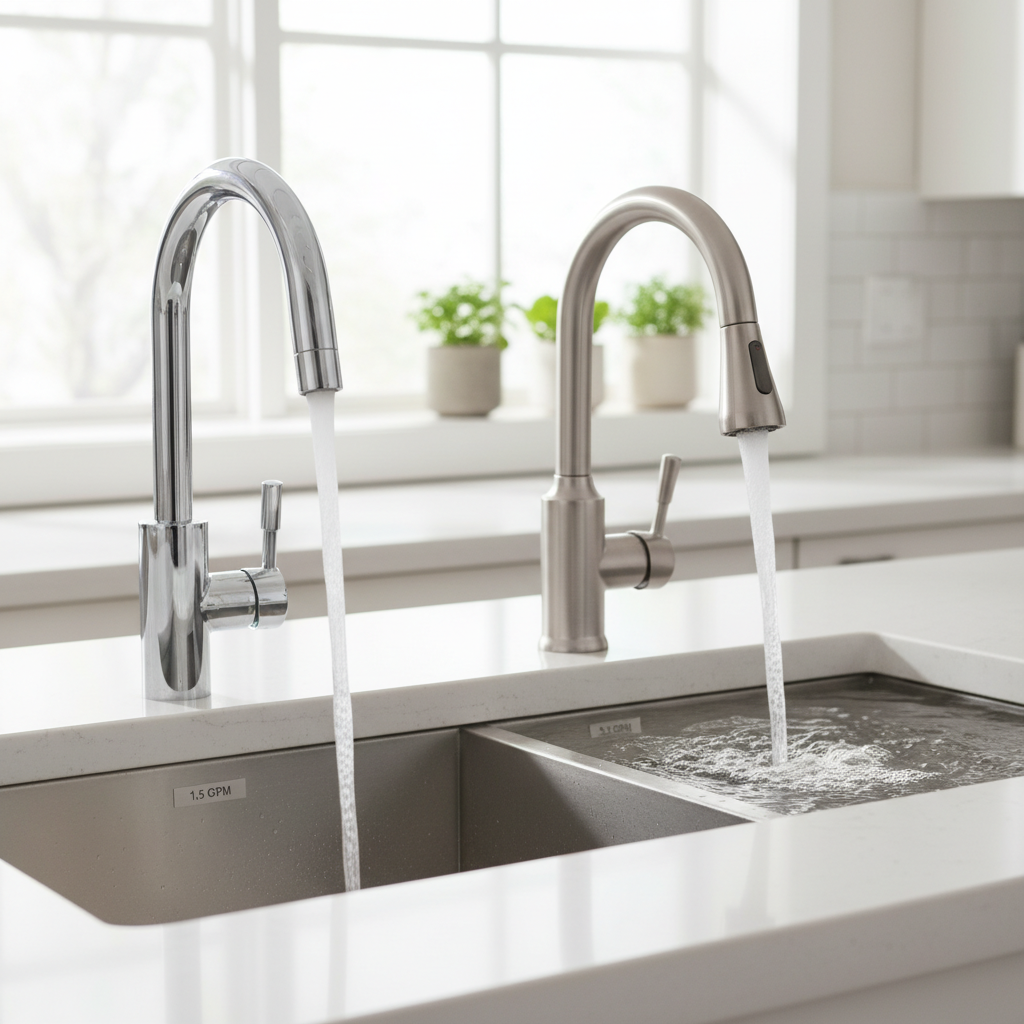
At its core, GPM (Gallons Per Minute) quantifies the volume of water flowing from your faucet in sixty seconds. This measurement is a key indicator of a fixture’s water efficiency and overall performance. A faucet’s flow rate is influenced by its internal design, the aerator installed at the spout, and your home’s incoming water pressure. Why does this number matter? It directly affects how much water your household consumes, the energy required to heat that water, and ultimately, your monthly expenses.
Federal standards in the United States currently mandate that kitchen and bathroom faucets manufactured after January 1, 1994, should not exceed a maximum flow rate of 2.2 GPM at 60 pounds per square inch (PSI) of pressure. However, many states and municipalities have adopted even stricter local regulations to promote greater conservation. The U.S. Environmental Protection Agency (EPA) WaterSense program goes a step further, specifying that residential bathroom lavatory faucets and accessories should have a maximum flow rate of 1.5 GPM or less to earn their high-efficiency label, representing a significant reduction in water usage from the federal standard.
2.2 GPM Faucets: The Traditional Standard
For decades, the 2.2 GPM faucet has been the widely accepted standard in many homes, offering a robust and seemingly powerful stream of water. These faucets deliver 2.2 gallons of water every minute they are fully open.
Advantages of 2.2 GPM Faucets
|
Our Picks for the Best High pressure faucet in 2026
As an Amazon Associate I earn from qualifying purchases.
|
||
| Num | Product | Action |
|---|---|---|
| 1 | AIMADI Kitchen Faucet with Pull Down Sprayer,Commercial Stainless Steel Pull Down Sprayer Kitchen Faucet Single Hole Single Handle RV Laundry Outdoor Kitchen Sink Faucets |

|
| 2 | Chrome Brass Wall Mount Faucet, Single Cold Water Utility Tap, G 1/2 Inch Connection for Laundry Sink, Mop Basin, Garage, Outdoor Garden Hose |
|
| 3 | TIORIY Kitchen Faucet Head with 15 Adapters, High Pressure 3 Functions Pull Down Kitchen Spray Head Replacement, Pull Out Kitchen Sink Sprayer Nozzle, Brushed Gold, ABS |
|
| 4 | 3-Adjustable Water Pressure Faucet with Booster Shower Heads - ABS Material, Extended Spout, Anti-Splash, Universal Connector |
|
| 5 | Kitchen Faucet with Pull Down Sprayer, High Arc Single Handle Brushed Nickel Stainless Steel 1 or 3 Hole Faucet for Kitchen Sink, Farmhouse, RV, Laundry, Bar, Outdoor |
|
| 6 | FORIOUS Kitchen Faucets with Pull Down Sprayer, Brushed Nickel, High Arc Single Handle Classic Stainless Steel Sink Faucet 1 or 3 Hole, Suitable for Farmhouse Camper Laundry Rv Bar |
|
| 7 | Inchant Outdoor Kitchen Sink Faucet - 360° Rotatable Single Hole Single Handle Cold Water Kitchen Faucet Flexible Neck Laundry Room Tap Bar Garden Outdoor Faucet, Deck Mount Chrome Finish |
|
| 8 | GIMILI Kitchen Faucet with Pull Down Sprayer Single Handle High Pressure Kitchen Sink Faucet Commercial Double-Headed Stainless Steel Kitchen Faucets Brushed Nickel and Black |
|
| 9 | 2PCS 360 Degree Swivel Faucet Aerator Deluxe Water Saving Faucet Sprayer Water Saving Bubbler Pressurized Faucet Filter Kitchen Accessories (360 Degree, Count, 2) |
|
| 10 | TMOK 1/2" x 3/4" Brass Outdoor Faucet & High Pressure Jet Nozzle with Leakproof Shut Off Valve, Heavy-Duty Brass 3/4" GHT Hose Nozzle with 4 Garden Hose Rubber Washers, Teflon Tape |
|
Traditionally, the primary appeal of a 2.2 GPM faucet lies in its forceful output. This higher flow rate is often preferred for tasks requiring rapid water delivery, such as quickly filling large pots for cooking or rinsing away stubborn food debris from dishes. Many users associate this higher GPM with a more powerful and effective wash, finding it suitable for general household use. The broad availability of these fixtures has also made them a familiar and straightforward choice for many homeowners.
Disadvantages of 2.2 GPM Faucets
Despite their perceived power, 2.2 GPM faucets are inherently less water-efficient. This higher flow rate can lead to significant water wastage during routine tasks like handwashing or light rinsing, where a full stream isn’t always necessary. Consequently, homes equipped primarily with 2.2 GPM faucets often experience higher water consumption, which translates directly into increased utility bills for both water and the energy used to heat it. From an environmental perspective, their greater water usage means a larger carbon footprint compared to more efficient alternatives.
Best Use Cases for 2.2 GPM Faucets
While the trend leans towards conservation, 2.2 GPM faucets might still be considered for specific applications. They are most commonly found in kitchen sinks where the need for quick pot filling or powerful rinsing of larger items is prioritized. For utility sinks in laundry rooms or garages, where efficiency is less of a concern than speed and volume, a 2.2 GPM faucet could also be a practical choice. However, even in these scenarios, many high-efficiency options now offer comparable performance with less water.
1.5 GPM Faucets: The High-Efficiency Choice
Representing a significant step forward in water conservation, 1.5 GPM faucets adhere to the EPA’s WaterSense criteria, offering a more mindful approach to water usage without sacrificing functionality. These fixtures deliver 1.5 gallons of water per minute when fully open.
Advantages of 1.5 GPM Faucets
The most compelling benefit of 1.5 GPM faucets is their impressive water and energy savings. Switching from a 2.2 GPM faucet to a 1.5 GPM model can reduce water usage by up to 30%, conserving hundreds of gallons annually for an average household. This reduction directly translates into lower monthly utility bills, as you’re paying for less water and less energy to heat it. Beyond the financial savings, these faucets significantly reduce your home’s environmental impact, making them an excellent choice for eco-conscious individuals. Modern 1.5 GPM designs are engineered to maintain adequate water pressure and a satisfying stream, often utilizing advanced aerators to enhance performance despite the lower flow. They are particularly well-suited for bathroom sinks and general handwashing, where a high volume isn’t typically required.
Disadvantages of 1.5 GPM Faucets
While highly efficient, 1.5 GPM faucets might present a perceived disadvantage for certain tasks. Some users accustomed to higher flow rates might initially find the stream slightly less forceful. For very specific situations, such as filling extremely large vessels rapidly, a 1.5 GPM faucet could take a little longer. Additionally, in homes that already suffer from inherently low water pressure, even a well-designed 1.5 GPM faucet might not provide the desired robust flow, although this can often be mitigated by addressing the underlying pressure issues.
Best Use Cases for 1.5 GPM Faucets
1.5 GPM faucets are ideal for most household applications, particularly in bathrooms. For handwashing, brushing teeth, and light cleaning, a 1.5 GPM flow rate is more than sufficient, preventing splashing and unnecessary waste. In kitchens, many everyday tasks like washing dishes, rinsing produce, and filling smaller containers are handled perfectly well by a 1.5 GPM faucet. They are an excellent choice for any homeowner looking to reduce their water footprint, save on utility costs, and comply with stricter local water conservation mandates.
Flow Rate vs. Water Pressure: Clarifying the Confusion
It’s common to confuse water flow rate (GPM) with water pressure (PSI – Pounds per Square Inch), but they are distinct concepts. Flow rate refers to the volume of water coming out over time, while pressure refers to the force with which that water is delivered. A common misconception is that a lower GPM automatically means less water pressure, leading to a weak or ineffective stream.
However, this isn’t necessarily true. While a higher GPM generally can deliver a more powerful, full-coverage spray, especially in showerheads, modern faucet designs and aerators play a critical role in how pressure is perceived. Many low-flow faucets are specifically engineered with optimized spray nozzles or pressure-boosting technology to maintain a satisfying and effective stream, even with reduced water volume. Confining the water stream with a well-designed aerator can actually increase the perceived force of the water as it exits the faucet, providing a strong spray without using excessive water. The goal is to achieve an effective force for cleaning and rinsing while minimizing the overall water volume used.
Choosing the Right Flow Rate for Your Home
Selecting the ideal faucet flow rate involves balancing your household’s practical needs with your desire for efficiency and conservation.
Key Factors to Consider
First, assess your daily water usage habits. Do you frequently fill large pots in the kitchen? Or is your faucet primarily used for handwashing and light rinsing? Consider your existing water pressure; if it’s already on the lower side, you might need to weigh the benefits of conservation against the potential for a less powerful stream, though many modern low-flow faucets are designed to mitigate this. It’s also important to be aware of any local water conservation regulations or rebates that might encourage or even require lower GPM fixtures in your area. Finally, factor in your budget; while high-efficiency faucets might have a slightly higher upfront cost, the long-term savings on water and energy can quickly offset this.
Recommendations for Your Home
For bathroom sinks, a 1.5 GPM faucet is almost always the superior choice. It provides ample water for handwashing and personal hygiene, prevents splashing, and significantly conserves water. In the kitchen, if you frequently fill large containers quickly, a 2.2 GPM faucet might seem appealing, but for most everyday tasks, a 1.5 GPM or even a 1.8 GPM model with a well-designed aerator offers a good balance of performance and efficiency. Always look for the WaterSense label on faucets, as this certification guarantees that the product meets strict water efficiency criteria while maintaining satisfactory performance.
Upgrading Your Faucets: Tips for Improving Efficiency
Even if you’re not replacing your entire faucet, you can often improve its water efficiency. One of the simplest and most effective upgrades is replacing an old or inefficient aerator. These small devices screw onto the tip of your faucet and regulate the flow rate. Upgrading to a 1.5 GPM WaterSense-labeled aerator is an easy and inexpensive way to reduce water consumption without a full faucet replacement. When purchasing new fixtures, prioritizing those with the WaterSense label ensures you’re getting a product designed for optimal water efficiency. If you’re unsure about installation or have concerns about your home’s water pressure, consulting with a plumbing professional can provide peace of mind and ensure everything is set up correctly.
Conclusion
The choice between a 1.5 GPM and 2.2 GPM faucet is more than just a number; it’s a decision that impacts your household’s daily functionality, utility costs, and environmental footprint. While 2.2 GPM faucets offer a traditionally powerful flow, modern 1.5 GPM options provide substantial water and energy savings with minimal compromise on performance, especially for common tasks. By understanding the distinction between flow rate and water pressure, considering your specific needs, and opting for WaterSense-labeled products, you can make an informed choice that benefits both your home and the planet. Evaluate your current faucets today – perhaps it’s time to embrace the efficiency of a lower GPM.
What small change will you make to improve your home’s water efficiency this year?
Frequently Asked Questions
What does GPM mean for faucets?
GPM stands for Gallons Per Minute and measures the volume of water that flows out of your faucet in one minute. It’s a key indicator of a faucet’s water efficiency and how much water your household consumes.
Is 1.5 GPM enough for a kitchen faucet?
For many everyday kitchen tasks like washing dishes, rinsing produce, and general handwashing, a 1.5 GPM faucet is highly efficient and provides sufficient water flow. While it might take slightly longer to fill very large pots compared to a 2.2 GPM model, the water savings are significant.
Will a 1.5 GPM faucet reduce my water pressure?
Not necessarily. While GPM refers to water volume and PSI (Pounds per Square Inch) refers to pressure, modern 1.5 GPM faucets often incorporate advanced aerator designs to maintain effective water pressure and a satisfying stream, ensuring performance isn’t compromised despite using less water.
What are the federal regulations for faucet flow rates?
Federal standards dictate that kitchen and bathroom faucets manufactured after 1994 must have a maximum flow rate of 2.2 GPM. However, the EPA WaterSense program encourages even greater efficiency, setting a standard of 1.5 GPM or less for qualifying bathroom faucets.
How much water can I save with a 1.5 GPM faucet?
By switching from a standard 2.2 GPM faucet to a 1.5 GPM high-efficiency model, you can reduce your water consumption by approximately 30%. This translates to significant savings on both your water and water heating utility bills over time, while also reducing your environmental impact.