Selecting a new faucet for your kitchen or bathroom goes beyond choosing a stylish finish; it’s a decision that profoundly impacts daily functionality and the overall aesthetic harmony of your space. The height and reach of your faucet are critical dimensions that, if overlooked, can lead to frustrating splashing, awkward usage, or even installation mishaps. Understanding these measurements and how they interact with your sink and surrounding environment is the key to a successful and satisfying upgrade. This comprehensive guide will walk you through everything you need to know, from defining key terms to offering practical tips, ensuring you select a faucet that looks perfect and performs flawlessly.
Understanding Faucet Height and Reach
Before diving into selection, let’s clarify the fundamental dimensions that will guide your choice:
- Spout Reach: This is the horizontal measurement from the center of the faucet’s base (where it connects to the sink or countertop) to the point where the water exits the spout. It determines how far the water stream extends into your sink basin. A typical range for kitchen faucets is 8–12 inches, while bathroom faucets usually range from 4–6 inches.
- Spout Height: This refers to the vertical distance from the faucet’s base to the water exit point. It dictates the clearance available beneath the spout, affecting your ability to wash hands comfortably or fill tall containers. Kitchen spout heights often fall between 6–12 inches, and bathroom spouts are generally 3–6 inches.
- Overall Height: This is the total vertical measurement from the faucet’s base to its very highest point, including any decorative elements or handles. This dimension is crucial for ensuring the faucet fits beneath overhead cabinets, shelves, or windowsills, and also influences its visual presence in the room. Kitchen faucets can range from 8–20 inches, with bathroom faucets typically between 6–10 inches.
These measurements are not just technical specifications; they directly translate to your daily experience. The right spout reach ensures water lands comfortably in the center of the basin, preventing messy splashing and optimizing tasks. Adequate spout height provides the necessary clearance, whether you’re washing hands, scrubbing dishes, or filling a large pot. Finally, a well-chosen overall height guarantees a seamless fit within your existing space, contributing to both practical utility and aesthetic balance.
Key Factors to Consider When Choosing Faucet Height and Reach
Selecting the perfect faucet dimensions involves a thoughtful balance between your sink, surrounding space, and how you intend to use the faucet. Each element plays a crucial role:
Sink Dimensions and Type
The size and shape of your sink are the most significant factors in determining appropriate faucet height and reach.
- Sink Width: For optimal functionality and to prevent splashing, the faucet’s spout reach should ideally extend to approximately 50-70% of your sink’s width. For instance, a 16-inch sink typically pairs well with a 7- to 9-inch reach, while a wider 30-inch sink might require a 10- to 12-inch reach.
- Sink Depth: The depth of your sink bowl directly impacts the ideal spout height. Shallow sinks, usually 6-8 inches deep, benefit from lower spout heights (around 3-6 inches) to minimize splashing. Conversely, deeper sinks (10-12 inches) can accommodate and often require higher spouts (8-12 inches) to provide ample clearance without causing water to hit the sink’s edge awkwardly.
- Sink Type: Specific sink types have unique requirements. Vessel sinks, which sit atop the countertop, demand significantly taller faucets to ensure the spout clears the rim and water flows into the basin. Undermount sinks, conversely, allow for more flexibility in spout height as the rim is below the countertop level.
|
Our Picks for the Best High pressure faucet in 2026
As an Amazon Associate I earn from qualifying purchases.
|
||
| Num | Product | Action |
|---|---|---|
| 1 | Inchant Outdoor Kitchen Sink Faucet - 360° Rotatable Single Hole Single Handle Cold Water Kitchen Faucet Flexible Neck Laundry Room Tap Bar Garden Outdoor Faucet, Deck Mount Chrome Finish |

|
| 2 | FORIOUS Kitchen Faucets with Pull Down Sprayer, Brushed Nickel, High Arc Single Handle Classic Stainless Steel Sink Faucet 1 or 3 Hole, Suitable for Farmhouse Camper Laundry Rv Bar |
|
| 3 | Chrome Brass Wall Mount Faucet, Single Cold Water Utility Tap, G 1/2 Inch Connection for Laundry Sink, Mop Basin, Garage, Outdoor Garden Hose |
|
| 4 | AIMADI Kitchen Faucet with Pull Down Sprayer,Commercial Stainless Steel Pull Down Sprayer Kitchen Faucet Single Hole Single Handle RV Laundry Outdoor Kitchen Sink Faucets |
|
| 5 | GIMILI Kitchen Faucet with Pull Down Sprayer Single Handle High Pressure Kitchen Sink Faucet Commercial Double-Headed Stainless Steel Kitchen Faucets Brushed Nickel and Black |
|
| 6 | Kitchen Faucet with Pull Down Sprayer, High Arc Single Handle Brushed Nickel Stainless Steel 1 or 3 Hole Faucet for Kitchen Sink, Farmhouse, RV, Laundry, Bar, Outdoor |
|
| 7 | TMOK 1/2" x 3/4" Brass Outdoor Faucet & High Pressure Jet Nozzle with Leakproof Shut Off Valve, Heavy-Duty Brass 3/4" GHT Hose Nozzle with 4 Garden Hose Rubber Washers, Teflon Tape |
|
| 8 | 3-Adjustable Water Pressure Faucet with Booster Shower Heads - ABS Material, Extended Spout, Anti-Splash, Universal Connector |
|
| 9 | 2PCS 360 Degree Swivel Faucet Aerator Deluxe Water Saving Faucet Sprayer Water Saving Bubbler Pressurized Faucet Filter Kitchen Accessories (360 Degree, Count, 2) |
|
| 10 | TIORIY Kitchen Faucet Head with 15 Adapters, High Pressure 3 Functions Pull Down Kitchen Spray Head Replacement, Pull Out Kitchen Sink Sprayer Nozzle, Brushed Gold, ABS |
|
Countertop and Surrounding Space
The area around your sink dictates the maximum dimensions your faucet can occupy.
- Backsplash Proximity: Ensure the faucet’s body and handles have sufficient clearance from the backsplash, allowing for comfortable operation and cleaning.
- Overhead Obstructions: Measure the distance from the faucet mounting area to any cabinets, shelves, or windowsills above. The faucet’s overall height must fit comfortably within this space to avoid installation issues and maintain visual appeal.
- Handle Clearance: If you choose a faucet with handles on either side, verify that there’s enough space for them to turn freely without hitting the wall or other fixtures.
Faucet Type and Design
Different faucet designs naturally come with varying height and reach characteristics.
- Fixed Spouts: Common in bathrooms, these offer consistent spout reach and height.
- Pull-Down/Pull-Out Faucets: Popular in kitchens, these provide the flexibility of an extendable sprayer, effectively increasing reach and versatility for tasks like rinsing large pots or cleaning the sink. While listed measurements reflect their resting position, their functionality extends beyond these static dimensions.
- Low-Arc vs. High-Arc Faucets: Low-arc faucets, typically under 8 inches in spout height, are compact and ideal for smaller sinks or spaces where a minimalist look is desired. High-arc (or gooseneck) faucets, often exceeding 12 inches in spout height, offer substantial clearance, making them perfect for filling tall containers or washing large items. However, pairing a high-arc faucet with a shallow sink can increase the risk of splashing.
Usage Needs and Ergonomics
Consider how you and your family primarily use the sink.
- Kitchen Usage: If you frequently fill large pots, clean oversized baking sheets, or wash children’s hands, a longer spout reach (8-12 inches) and a higher spout height (8-12 inches) will be far more practical. The overall height, often 12-20 inches for kitchen faucets, should also fit under any cabinets.
- Bathroom Usage: For general handwashing and face rinsing, a shorter spout reach (4-6 inches) and spout height (3-6 inches) are typically sufficient, preventing excessive splashing. Bathroom faucets usually have an overall height of 6-10 inches for a balanced look.
- User Height and Accessibility: Taller users might prefer higher spouts to avoid bending excessively, while individuals with limited mobility might benefit from single-handle or lever-style faucets that are easy to operate.
Aesthetics and Proportionality
Beyond pure functionality, the faucet should visually complement its surroundings. An oversized faucet can overwhelm a small sink and countertop, making the space feel cramped, while a tiny faucet might look lost on a large basin, disrupting the visual balance. Achieving aesthetic harmony means selecting dimensions that are proportionate to your sink and the overall design style of your room.
How to Accurately Measure for Your New Faucet
Accurate measurement is the cornerstone of choosing the right faucet. Here’s a step-by-step guide to ensure you get it right:
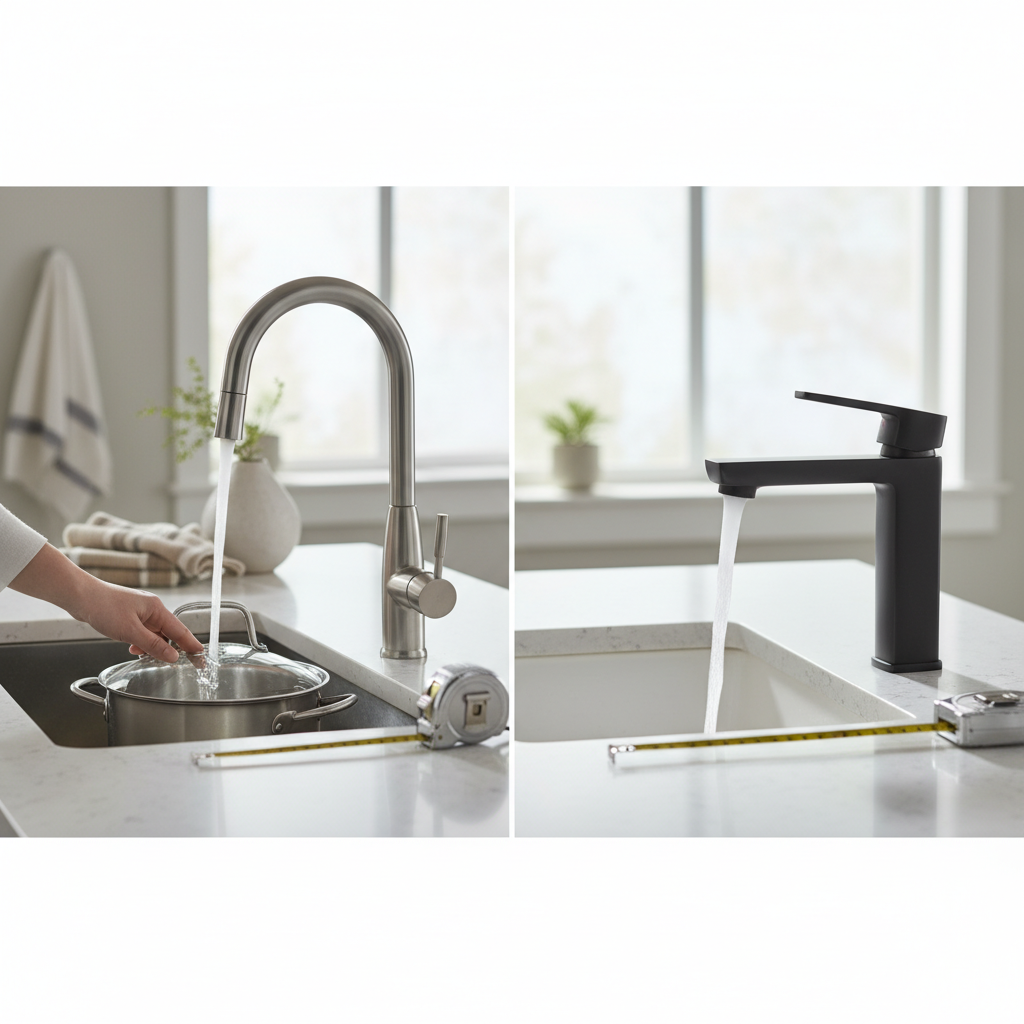
- Measure Faucet Height: Use a tape measure to determine the vertical distance from the countertop (or sink deck) to the highest point of the existing faucet. This gives you the overall height. Then, measure from the countertop to the water exit point (spout tip) for the spout height.
- Measure Faucet Reach: Measure horizontally from the center of the faucet’s base on the countertop to the water exit point of the spout. This is the spout reach. For pull-down or pull-out faucets, measure to the resting position of the sprayer head.
- Measure Sink Dimensions: Note the interior width and depth of your sink basin. For width, measure from side to side; for depth, measure from the bottom of the basin to the top edge.
- Check Clearances:
- Overhead: Measure from the faucet’s mounting location straight up to the bottom of any cabinets, shelves, or windowsills.
- Behind: Measure the distance from the faucet mounting holes to the backsplash or wall to ensure ample space for the faucet body and handles.
- Mounting Holes: Count the number of pre-drilled holes in your sink or countertop and measure the distance between their centers (hole spacing). This will determine the type of faucet you can install (e.g., single-hole, widespread, centerset).
Record all these measurements meticulously. They will be invaluable when comparing different faucet models and their specifications.
Common Mistakes to Avoid When Selecting Faucet Dimensions
Even with careful planning, it’s easy to fall into common traps. Being aware of these can save you a lot of hassle:
- Choosing a Faucet Too Tall for a Shallow Sink: This is a recipe for splashing. If your sink is shallow, a high-arc faucet can cause water to rebound out of the basin, creating a constant mess.
- Faucet Reach Too Short: When the spout doesn’t extend far enough into the sink, water might hit the sink’s rim, making handwashing awkward and causing splashes outside the basin.
- Ignoring Overhead Clearance: A beautiful, tall faucet won’t be so appealing if it bumps into your medicine cabinet or blocks your window. Always double-check the overall height against any overhead obstructions.
- Forgetting Handle Clearance: Especially with widespread faucets or those with side handles, ensure there’s enough room for the handles to turn fully without hitting a wall, backsplash, or other fixtures.
- Underestimating Sink Use: Don’t just pick based on aesthetics. Think about your daily habits. If you wash large items often, you’ll regret a low spout height.
Top Faucet Styles and Their Typical Height and Reach Considerations
Faucets come in various configurations, each with its own dimensional considerations:
- Single-Hole Faucets: These are mounted through a single hole in the sink or countertop and often come in diverse designs, from compact to high-arc, offering flexibility in height and reach.
- Centerset Faucets: Designed for sinks with three holes, typically 4 inches apart, these faucets have the spout and handles integrated onto a single base. They generally feature more standard, compact heights and reaches suitable for most bathroom sinks.
- Widespread Faucets: Also for three-hole installations, widespread faucets allow the spout and handles to be installed independently, usually 8 inches apart. While this offers more aesthetic flexibility for handle placement, the spout’s height and reach remain fixed.
- Wall-Mounted Faucets: These faucets are installed directly into the wall, freeing up counter space. Their reach is fixed by their placement on the wall, so precise planning regarding sink position and spout extension is crucial to prevent water from hitting the sink’s edge or splashing excessively.
- Vessel Sink Faucets: Specifically designed for vessel sinks, these faucets are considerably taller than standard models to ensure the spout clears the sink’s raised rim and extends adequately over the basin.
Installation and Maintenance Tips for Optimal Faucet Performance
Ensuring a perfect fit doesn’t end with choosing the right dimensions. Proper installation and ongoing maintenance are equally important.
- Re-check Measurements Before Purchase: Before making a final purchase, always verify the exact dimensions of your chosen faucet model against your recorded measurements. Product specifications can sometimes vary slightly between manufacturers.
- Professional Installation: While many DIY enthusiasts can tackle faucet installation, for complex setups or wall-mounted faucets, consulting a licensed plumber can prevent costly errors and ensure optimal water flow and leak-free operation.
- Test for Splashing: After installation, run the water at various pressures to confirm that the stream lands correctly in the sink and doesn’t cause excessive splashing outside the basin. Minor adjustments to water pressure or the aerator can sometimes help.
- Regular Cleaning: To maintain your faucet’s appearance and prevent mineral buildup that could affect water flow, clean it regularly according to the manufacturer’s guidelines for its specific finish. Ensure all areas around the spout are kept clean.
Expert Insight
“The ultimate goal when selecting a faucet is to achieve a seamless blend of form and function. Don’t sacrifice usability for aesthetics, nor ignore design for pure practicality. The ideal faucet height and reach will feel intuitive in daily use and visually enhance your space.” – Johnathan Davis, Senior Kitchen & Bath Designer
Conclusion
Choosing the right faucet height and reach is a crucial decision that profoundly impacts the comfort, functionality, and visual appeal of your kitchen or bathroom. By understanding the definitions of spout reach, spout height, and overall height, and carefully considering your sink’s dimensions, the surrounding space, and your specific usage needs, you can make an informed choice. Take the time to measure accurately, avoid common pitfalls, and envision how your chosen faucet will integrate into your daily routine. A well-selected faucet is an investment that enhances your home’s efficiency and beauty for years to come.
What steps will you take today to ensure your next faucet purchase is the perfect fit?
Frequently Asked Questions
What is the ideal spout reach for a kitchen sink?
The ideal spout reach for a kitchen sink typically ranges from 8 to 12 inches. It should extend far enough to land water near the center of the sink, ideally covering 50-70% of the sink’s width, to allow for comfortable use and minimize splashing.
How tall should a faucet be for a vessel sink?
Faucets for vessel sinks need to be considerably taller than standard faucets. The spout height must be sufficient to clear the top rim of the vessel sink, typically requiring a spout height of 8 to 14 inches or more, depending on the sink’s height.
Can a faucet be too tall for a bathroom sink?
Yes, a faucet can be too tall for a bathroom sink, especially if the sink is shallow. An overly tall spout can lead to excessive splashing, making a mess around the basin. It can also look disproportionate and interfere with overhead cabinets or mirrors.
What happens if my faucet’s reach is too short?
If your faucet’s reach is too short, the water stream will hit the back rim of the sink basin instead of the center. This makes washing hands or items awkward, potentially forcing you to bump your hands against the sink’s edge and causing water to splash out.
Does faucet height affect water pressure?
Generally, faucet height does not significantly affect water pressure at the spout itself. However, very tall or high-arc faucets might experience a slight, almost negligible, reduction in flow rate due to gravity, though this is rarely a noticeable issue in most residential settings.
How do I measure for a wall-mounted faucet?
For a wall-mounted faucet, measure the horizontal distance from the wall (at the mounting point) to the desired water exit point over the sink. This measurement determines the required spout reach. Also, measure the vertical distance from the countertop to the faucet’s intended mounting height on the wall.